a walkthrough of the house you already live in

Your home smells clean.
But is it safe?

In the US, a cleaning product can reach your shelf without a single pre-market safety test. And one word on the back — "fragrance" — can legally hide hundreds of undisclosed compounds. The label won't tell you. This walkthrough will.

Start the walkthrough 5 rooms · 4 minutes · no fear-mongering, just the research
scroll
The story behind the book

It started with a bottle I'd never read.

Italo Campilii spent twenty-one years fighting Crohn's disease. Hospitalizations that blurred together. Every protocol, every elimination diet, every specialist with a three-month waitlist — and the flares kept coming.

The shift didn't happen in a doctor's office. It happened in his kitchen, holding a bottle of all-purpose cleaner, reading the back for the first time in his life.

"The spray I'd been using on my countertops contained chemicals that peer-reviewed research had linked to endocrine disruption, respiratory irritation, and gut inflammation."

That week he threw out nearly every cleaning product he owned. Not out of panic — out of attention. Within months of switching to genuinely simple alternatives, the flares became less frequent. The Toxic Home Fix is the book he wishes someone had handed him twenty years earlier.

The walkthrough

Five rooms. Five honest conversations.

the air nursery bathroom kitchen laundry
ROOM 01

The Nursery

A crawling baby's breathing zone is inches from the floor — where heavier-than-air chemicals from cleaning products concentrate. Their hands press into that floor, then go straight into their mouths.

What hides hereA 2017 study in Environmental Science & Technology found cleaning-product chemicals persist on floors for days after application — residual surfactants, fragrances, and antimicrobials detected up to a week later.
The fixIf you change only one product in your home, make it your floor cleaner. A microfiber mop, hot water, and a small amount of a genuinely clean plant-based concentrate — no residue film for little hands to pick up.

From Chapter 3 — The Nursery and Kids' Rooms

ROOM 02

The Kitchen

You clean the surfaces that touch your food. Residue from your dish soap ends up in your mouth. And "disinfecting" your counters twice a day with quat-based sprays likely exposes your family to more chemical risk than the bacteria it kills.

What hides hereSLS/SLES surfactants (with possible 1,4-dioxane contamination — an EPA probable human carcinogen), synthetic fragrance, and quats — linked in occupational studies to asthma in professional cleaners.
The fixSoap and water physically removes bacteria — that's sanitizing, and it's enough for a home kitchen. Suds are mostly theater; plant-based surfactants like decyl glucoside clean grease without the skin-barrier damage.

From Chapter 4 — The Kitchen

ROOM 03

The Bathroom

Enclosed space. Limited ventilation. The most chemically aggressive products in your home — and the most common location for accidental chemical-mixing incidents that send people to the ER.

What hides hereBleach doesn't kill mold on porous surfaces — it bleaches it. The roots stay embedded in grout and caulk, and the water content in bleach feeds regrowth. Meanwhile bleach + acid toilet cleaner = chlorine gas.
The fixFour things replace nine products: a plant-based all-purpose cleaner, white vinegar, baking soda, and 3% hydrogen peroxide — which actually penetrates porous surfaces and kills mold at the root.

From Chapter 5 — The Bathroom

ROOM 04

The Laundry Room

The most intimate chemical exposure in your house: whatever is in your detergent sits against your family's skin all day and all night. The fragrance doesn't wash out — it's engineered not to.

What hides hereA University of Washington study found dryer vents using fragranced laundry products emitted 25+ VOCs — including acetaldehyde and benzene, carcinogens with no established safe exposure threshold.
The fixA truly fragrance-free detergent (read ingredients, not front-label claims) and wool dryer balls — they soften through physical action, last 1,000+ loads, and leave zero chemical coating behind.

From Chapter 6 — The Laundry Room

ROOM 05

The Air Itself

Your child's bedroom, where they spend 10–12 hours a day, should have the cleanest air in the house. A plug-in air freshener pumps synthetic fragrance compounds into that air all night long.

What hides hereHomes using air fresheners and plug-ins show measurably higher VOC levels — including formaldehyde — per research in Environmental Health Perspectives, worst in rooms with limited ventilation.
The fixA clean surface doesn't smell like anything. Find the odor's source and address it. Open a window. Ventilation is the free solution the cleaning aisle can't sell you.

From Chapters 3 & 7 — Air Fresheners / The Air Inside Your Home
The truth nobody prints on the label

The bar in the US isn't "this is safe." It's "this hasn't been proven dangerous enough to pull from shelves yet."

0chemicals banned or restricted in cleaning & personal care products by the EU
0roughly, banned or restricted in the US. Individual chemicals — not categories

And the single word "fragrance" on a label is a legal black box: dozens — sometimes hundreds — of undisclosed compounds, protected as trade secrets. US manufacturers are not required to prove ingredients safe before selling them.

A 10-second skill

Read the back of the bottle, not the front.

The front is marketing. "Natural," "green," and "eco" have no legal definition — a product can be 95% synthetic and still call itself plant-based. The only reliable way to know what's in a product is the full ingredient list.

Red flags to memorize: "fragrance" or "parfum" with no breakdown, quats (benzalkonium chloride), SLS/SLES, formaldehyde-releasing preservatives (DMDM hydantoin), and "antibacterial" claims on everyday products.

fresh lavender fields
Meadow Pure™

"Natural clean" · plant-derived

🌿

Ingredients (the part they hope you skip)
  • Water
  • Sodium laureth sulfate — possible 1,4-dioxane traces
  • Benzalkonium chloride — a quat; respiratory concerns
  • Fragrance — undisclosed mixture, trade secret
  • DMDM hydantoin — releases formaldehyde over time
  • Dye (Yellow 5)

"Meadow Pure" is a composite illustration of common conventional formulas — not a real brand.

tap the bottle to flip it

Free 5-lesson email course

The Home Walkthrough
— one room at a time, straight from the book

  1. Why "Clean" Got Hijacked — the fragrance loophole & the regulatory gap
  2. The Ingredient Hit List — 7 chemicals to know by name
  3. The Nursery Rules — why children are more vulnerable, and the floor problem
  4. Kitchen & Bathroom — the disinfection myth and the 4-item shelf
  5. Your Non-Toxic Kit — 5 ingredients, the swap method, the 5 red flags
The Toxic Home Fix book cover
The book · Trailhead Press

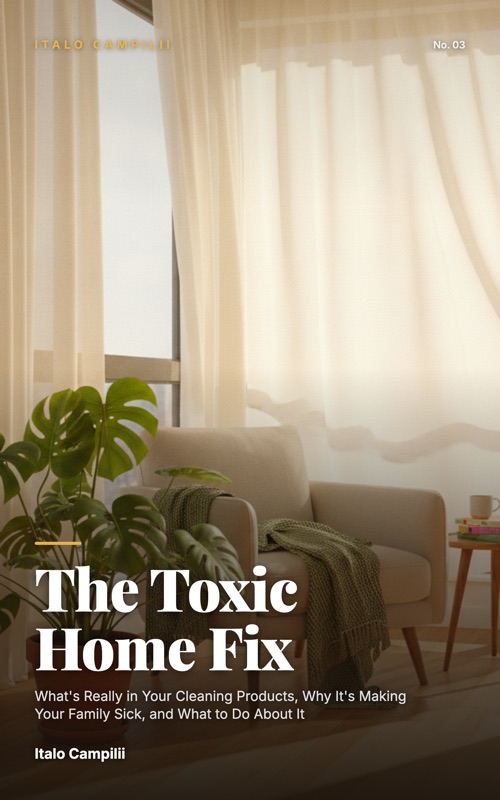
The Toxic Home Fix

What's Really in Your Cleaning Products, Why It's Making Your Family Sick, and What to Do About It — by Italo Campilii. Label-reading like a researcher, a full room-by-room audit, and the master swap list. No wellness fluff. Just the facts, the research, and a plan you can start this weekend.

The book is almost here. Join the notify list and you'll be first to know the moment it's live — course subscribers above are automatically on it.

Start with one room. Change everything.